jan. 6 was our failure
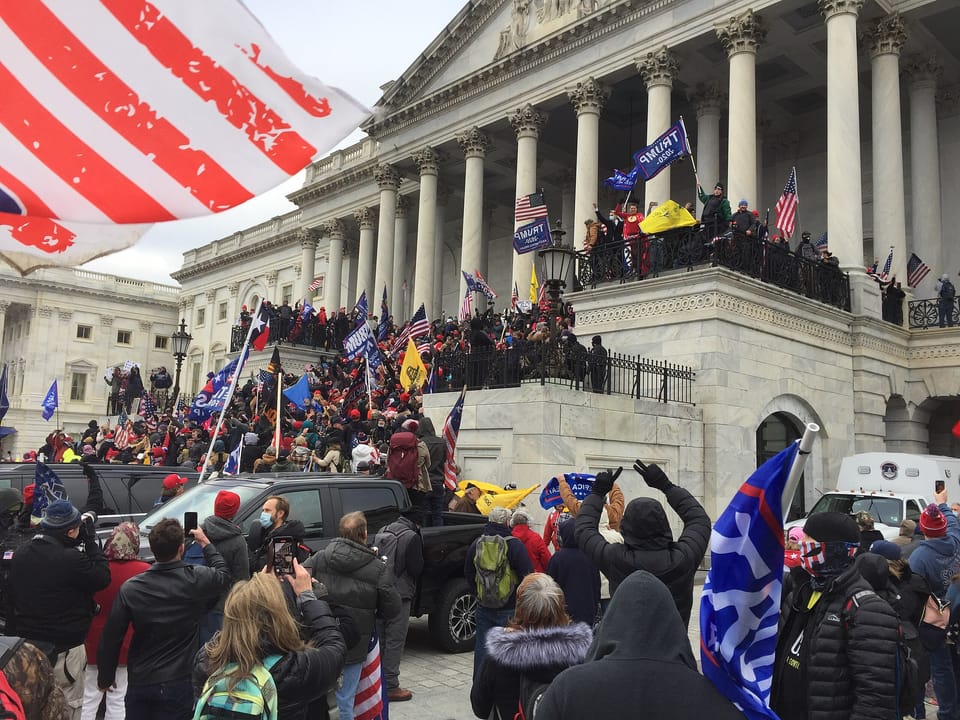
One of the things they don’t tell you about living in Washington, D.C., is how small it can feel. When I think of the absolutely psychotic shit that takes place here, I think of that bizarre Eric Adams quote about New York City and memories of 9/11. In case you forgot, here’s a refresher. When asked to summarize the city in 2023, Adams said: “This is a place where every day you wake up you could experience everything from a plane crashing into our trade center through a person who’s celebrating a new business that’s about to open.”
D.C. is, in many respects, just that. One day, armed Trump supporters could attack the United States Capitol building, killing multiple people. A few miles north, you could find yourself going on the first 5k run of the year in the city, because you know there’ll be a city-wide curfew tonight.
That afternoon, I hit the outskirts of Dupont Circle around the time that police evacuated Mike Pence. The chaos at the Capitol felt somewhat distant, though not too far. Before finding my way home, I passed a family walking away from the White House red QAnon hats and clutching American flags.
Describing Jan. 6 as a watershed moment for American history seems trite, but it’s also necessary because to a great extent the importance of that riot—that insurrection, that attempted coup—has been forgotten. On that afternoon in January, the U.S. political establishment set itself up for failure. Trump and his supporters left Washington, D.C., mostly unobstructed, and set to work crafting and promoting an alternative narrative around Jan. 6. Instead of forcing the coup plotters to the sidelines, their worldview now dominates the U.S. government.
***
This post is a confession: we failed. By “we,” I mean the lawmakers, civil society advocates, activists, journalists, and others who contributed, in some small way, to researching, exposing, or prosecuting those responsible for the riot. It isn’t a judgement; it’s a fact. On Jan. 20, 2025, the newly-re-elected President Trump pardoned some 1,600 people tied to the riot. At least 33 of those included in Trump’s blanket pardon have allegedly gone on to commit other crimes, according to an end-of-year analysis from Citizens for Responsibility and Ethics in Washington. Of course, many of those who supported the lie that the 2020 election had been stolen found their way into positions of power in Trump’s administration.
On the right, the machinations that made Trump’s pardons possible (if not plausible) started early on. Hours after the attack, multiple pro-Trump commentators and elected officials began boosting meritless claims that the rioters were antifascist activists, launching what the MIT Technology Review called an “instant conspiracy theory.” What began as a viral internet conspiracy found its way to Fox News prime time within hours. On the evening of the attack, Laura Ingraham tried to distance herself from the rioters, saying on her show that there were “some reports that antifa sympathizers may have been sprinkled throughout the crowd.” It’s unclear what she was referring to specifically, but as I wrote at the time, a company known as XRVision, a facial recognition group, had claimed—incorrectly, duh—to have identified two antifascists from Philadelphia present at the riot.
As convictions against rioters piled up, these attempts at deflecting blame for Jan. 6 paired uneasily with the same crowd’s glorification of it. Right-wing propagandists including Tucker Carlson and the authors at Revolver News, a junk news outlet with murky funding whose founder now works in the State Department, zeroed in on one man: former Oath Keepers chapter leader named Ray Epps, whom they falsely accused of being an agent provocateur. Within a period of six months, Marjorie Taylor Greene went from speculating about Epps’ actions that day to telling a roomful of extremists that, had she and Steve Bannon “organized” Jan. 6, “it would’ve been armed.” By the time 2024 rolled around, there was an insurrection-themed pinball machine at the annual Conservative Political Action Conference.
Within the right, though, these apparent contradictions have had minimal widescale impact. A CBS News poll published in 2025 found that the number of Republicans who voiced strong disapproval of the attack on the Capitol building dropped from 51% in 2021 to 30% in early 2025—an over 20% drop. His plan to embrace the rioters was not well-received either. Most Americans didn’t approve of Trump’s plan to pardon rioters—nor of his decision to then do so.
It’s easy to find possible points in the last five years where it could have gone differently. Recently, The New York Times’ editorial board pointed to Merrick Garland’s speed in prosecuting Trump, as well as the weaknesses in the state cases against him. Earlier, when the committee to investigate the attack started its work, others nodded to the hazards of it being a bipartisan approach. “It is hard to imagine that the 9/11 Commission would have performed as it did had it been staffed in part by people who found it politically advantageous to profess sympathies to al-Qaeda,” wrote Quinta Jurecic, Molly Reynolds, and Benjamin Wittes in a May 2021 article in Lawfare.
But these are all emblematic of a deeper, more existential issue. The questions that needed to be navigated after Jan. 6 were wide-reaching systematic ones—ones that the committee, or anything else, weren’t set up to answer. What do terms like “bipartisanship” even mean when someone strings up a noose on the Capitol lawn in a riot in support of one party’s leader? Why do tech companies, like the ones that enabled the rioters to plan and coordinate their attack, have such sway over democratic governance? What does “liberalism” or “democracy” even mean if it isn’t robustly defended? Is a democracy that we let go so easily one that is worth even protecting anymore? Is that even a democracy in the first place?
I don’t have the answers, but I’m confident that we’ll fail if we don’t try.