the not-so "golden age," one year on
Expo, a Swedish antiracist magazine that I contribute to, asked me to write a personal reflection how researching and reporting on the far right has felt during the first year of Donald Trump's return to office. The piece on their website is in Swedish, and they kindly let me publish the original draft that I filed in English here. If you can read Swedish and want to throw them a subscription, do it! They do great work.
In a similar vein, I had a short investigation into the Department of Homeland Security and other agencies, quite literally, stealing from white nationalists. It was published last week and is quite relevant here, too. You can read it on the Southern Poverty Law Center's website.
After reporting and researching the U.S. and international far right for nearly a decade, nothing about the administration’s draconian and authoritarian approach to governance surprised me. But I wasn’t prepared for what living through it would feel like.
For Americans with any semblance of conscience, 2025 was a horrific year. In Washington, D.C., where I live and work, we started the year with some of the country’s wealthiest people gathering at glitzy ballrooms downtown to celebrate Donald Trump’s return to office and the start of his promised “golden age.” We ended it as roving bands of federal law enforcement and immigration officers harassed, intimidated, and sometimes disappeared people from our streets.
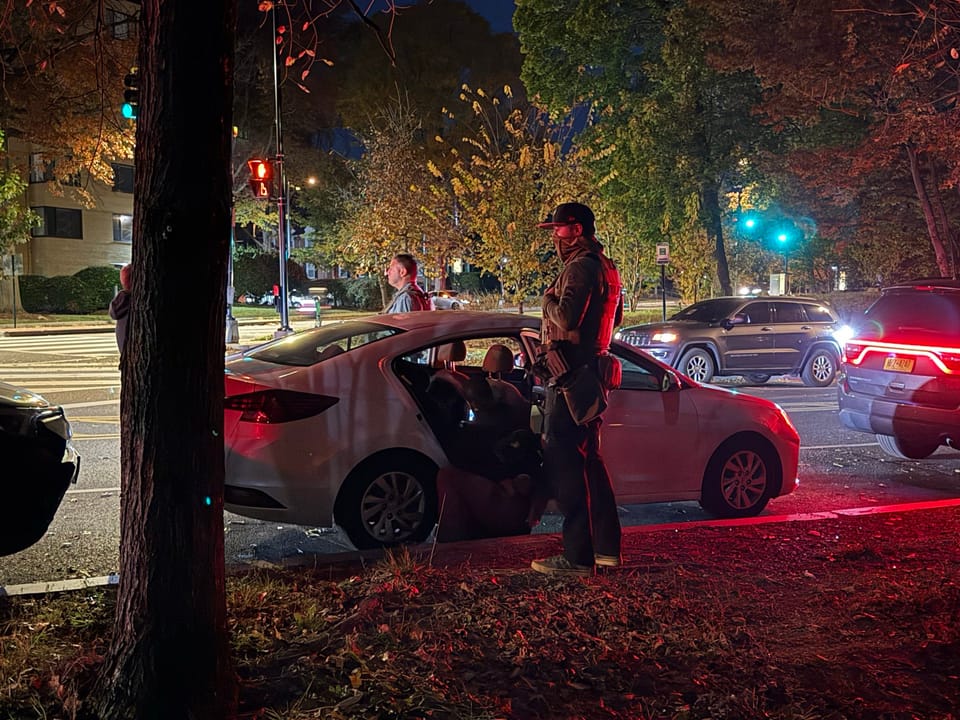
Over the summer, outside of Rock Creek Park — a 1,700 acre park featuring hiking, running, and biking trains that courses through the heart of the city — someone set up a large handcrafted sign warning that Immigration and Customs Enforcement officers were on patrol. One evening in early November, I witnessed what they meant. While walking on the park’s outskirts in a residential part of the city, I spotted a mob of cars blocking part of the thoroughfare near an entrance of the park. As I approached, I saw a law enforcement agent holding a child, who appeared to be no older than one- or two-years of age, while playing animated videos in Spanish on their phone. The child’s parent was nowhere in sight, but I had seen a few cars — all unmarked but clearly belonging to law enforcement — leaving as I had approached the group.
After I took out my phone to record the encounter, one of the officers, wearing a mask, turned to me and said: “Use the hashtag ‘rapist’ when you post the video.”
Was he saying the child’s parent was accused of rape? Or was it a reference to the administration’s own talking points around deportations? I didn’t ask what he meant, but it was clear the agents were irritated by the presence of observers. After the child’s remaining family arrived, the agents left — but not before one of them, wearing a black balaclava to cover his face, took out his phone to record those of us who stood by to bear witness to his and his colleagues’ actions.
The agents hate it when you film them. As I walked home, I hoped at least one of them was still mad about the presence of observers.
***
For me and my colleagues here in the United States whose work focuses on the far right, the past twelve months have felt like a bizarre, dystopian fever dream. The weirdness, for lack of a better word, extended well beyond the workplace. In May, my family learned that my mom — a recently retired political science professor — had her book removed from the U.S. Naval Academy after the Trump administration decided to purge its library of texts it believed promoted values of diversity, equity, and inclusion. I spent the summer and fall watching ICE agents kidnap my neighbors. A racist, ultra-Zionist group that I reported due to their involvement in the administration’s attempts to deport pro-Palestinian student activists sent me threatening messages about my dad after I reached out to them for comment.
Those who cover extremism saw this coming. Many of us had spent a decade — or more — warning that an extreme, fringe wing of the right that saw changing racial demographics in the United States as an existential threat had gained powerful allies in tech, politics, and business. We knew that for each extremist we identified in law enforcement, the military, civil service, government, political campaigns, and media there were more lying in wait. At this point, they basically confessed as much. When journalist Amanda Moore outed the co-host of white nationalist Richard Spencer’s podcast as a field director for Trump’s 2024 campaign, Luke Meyer, the co-host, told her: “Like the hydra, you can cut off my head and hold it up for the world to see, but two more will quietly appear and be working in the shadows.”
Other extremists have repeated similar refrains. In mid-October, Nick Fuentes, a white nationalist livestreamer who has described Adolf Hitler as “cool,” said on his nightly news show that his racist fans, who call themselves “groypers,” were in all parts of American society. “There’s groypers at Harvard. There’s groypers in all the Ivy League schools. I talked to all of them. There’s groypers in government. There’s groypers in every department. Every agency. Ok?” Fuentes said.
To what extent these proclamations are true is a matter of some debate. Nevertheless, if the first year of Trump’s second administration has taught us anything, it’s that the guardrails are off—and extremists know it. Trump made this point clear on his very first day in office when he signed an order pardoning or commuting the sentences of over 1,600+ Jan. 6, 2021, insurrectionists.
And on this front, Trump has continued to deliver. Since his inauguration, his administration has offered extremists a smorgasbord of victories. He’s torn apart civil rights protections and threatened birthright citizenship. He challenged the refugee status of thousands of non-white immigrants while offering amnesty to white South Africans so they can “avoid genocide.” His State Department established an office of “remigration,” using a term that has well-established roots in the racist fantasies of European neo-Nazis like Martin Sellner. He designated multiple left-wing militant groups as foreign terrorist organizations and laid the groundwork to target a broad swath of his political enemies. Public affairs staffers at his White House, Department of Homeland Security, Department of Labor, and other federal agencies communicate the administration’s draconian vision for the world on social media using memes and slogans popular with white supremacists.
But nothing has excited extremists more than Trump’s army of seemingly unaccountable masked immigration agents terrorizing left-leaning cities throughout the country. When an ICE agent named Jonathan Ross shot a 37-year-old mother in Minnesota, even neo-Nazis groups whose affiliates had been put in prison for federal crimes celebrated.
“Total smug-libtard-redditor decades long torture death can’t come soon enough,” an account associated with the neo-Nazi blog The American Futurist wrote on Telegram on Jan. 7.
As Trump’s first full year back in office comes to a close, it’s easy to feel despair. None of this — the 11 people shot by ICE or Border Patrol agents since September, the death of close to three dozen people in ICE detention centers, the threats to European allies that Trump has leveled, the gutting of America’s already limited and frayed social safety net, to name a few horrors — should be happening. And yet, throughout the country, communities have banded together to say “no.” Over the past several days, in the Twin Cities, protesters and community members have risen up to defend themselves against the 3,000 ICE agents that have descended on their city. Even as Trump repeatedly threatened to send in federal troops to quash protests, protesters braved the frigid winter cold to protect children, migrants, and other at-risk communities.
Watching videos from on-the-ground in Minneapolis, I couldn’t help but think of some of my family, half of whom are from the state. In one video that I watched on Bluesky, an older woman explained why she had joined a protest in northern Minneapolis, where much of ICE’s activity has been concentrated. Her attitude sounded eerily like my grandfather, who worked for decades as a small-town surgeon in northern Minnesota. He was a long-time liberal, though he didn’t look kindly on rudeness. He thought cursing was what you do when you don’t have anything better to say.
Evelyn Normielib (D-MN) has arrived at the scene of the ICE shooting in northern Minneapolis
— John Q. Public (@publius24.bsky.social) 2026-01-15T03:02:19.097Z
“Like I told the ICE people up there, this is the first time I’ve really felt hate,” the woman said. “I hate what they’re doing. I hate them for doing it.”
She’s got a point. After a year of watching U.S. leaders struggle to stand up to Trump, it was the first time in a long while that I felt inspired.